
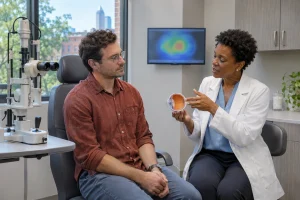
If you were told you are not a LASIK candidate, that does not mean you are out of options. Common reasons include thin corneas, an unstable prescription, severe dry eye, or an irregular cornea, and many patients move on to PRK, refractive lens exchange, or a treatment plan that makes LASIK possible later. Atlanta Vision Cataract and Laser Center in Hapeville reviews every option during a LASIK consultation.
What Does It Mean If You Are Not a LASIK Candidate?
It can feel discouraging to hear that LASIK is not right for you, especially when you have been looking forward to life without glasses. Take a breath. A no from one surgeon usually means a specific feature of your eyes makes LASIK a poor choice, not that vision correction is out of reach.
A good doctor tells you the truth, because protecting your eyes comes before booking a procedure. The next step is to understand why, and to learn what else is available.
Why Are Some Patients Not Good Candidates for LASIK?
LASIK reshapes the cornea after creating a thin flap, so the cornea has to be healthy, thick enough, and stable. The most common reasons a surgeon recommends against LASIK include the following.
- Corneas that are too thin for a safe flap
- An irregular cornea or signs of keratoconus
- A prescription that has changed recently
- Moderate to severe dry eye
- A very high prescription that exceeds the safe treatment range
- Certain health conditions or medications that affect healing
- Pregnancy or nursing, when hormones can change the eye
Our guide on who is a good candidate for LASIK explains the basics of candidacy in more detail.
Is the Answer Always Permanent?
Not always. Some reasons are temporary. A prescription that is still changing may stabilize. Dry eye can often be treated, and then your eyes can be measured again. Pregnancy and nursing eventually end. In these cases the answer may be “not yet,” rather than “never.”
If dry eye is the issue, our article on LASIK with dry eye in Atlanta explains how it is evaluated and treated, and our dry eye services can help you get your eyes ready for another look.
What Is PRK, and When Is It a Better Fit?
PRK corrects vision by reshaping the surface of the cornea without creating a flap. Because there is no flap, it is often a good fit for people with thinner corneas and for those whose lifestyles make a flap a concern. The tradeoff is that healing usually takes longer than with LASIK.
You can learn more on our PRK surgery page and in our comparison of PRK and LASIK. Many people who are turned down for LASIK are good candidates for PRK.
What About Refractive Lens Exchange?
Refractive lens exchange replaces the eye’s natural lens with an artificial lens. It is often considered by people over 40 who have a high prescription, or who are starting to develop cataracts or need reading help, because it can address several problems at once.
It is a different kind of procedure from LASIK, with its own benefits and risks. Our article on refractive lens exchange versus LASIK and our refractive lens exchange page explain who it suits.
What If You Have an Irregular Cornea or Keratoconus?
LASIK is not recommended for corneas that are bulging or irregular, because the procedure could make the shape worse. If you have keratoconus, there are other ways to protect and support your vision, such as corneal cross linking and specialty lenses. Our keratoconus services explain the options.
Early diagnosis matters, so if a surgeon has mentioned an irregular cornea, follow up promptly.
Are There Other Options Besides Surgery?
Yes. Glasses and contact lenses remain safe and effective ways to see clearly, and technology keeps improving. Our optical center can help you find a comfortable fit. Some patients wait and revisit surgery later, while others decide that glasses and contacts suit them well.
Other procedures, including implantable lenses, exist for certain patients, and your doctor can explain which options are appropriate and where they are offered.
Should You Get a Second Opinion?
A second opinion is reasonable, especially if you were rejected quickly or without a full exam. Different practices use different technology and standards, so a more thorough evaluation can sometimes reveal new options. Bring your records from the first visit so the new team can compare results.
Our guide on how to find the best LASIK surgeon lists questions worth asking at any consultation.
What Tests Show Whether LASIK Is Safe for You?
A candidacy exam goes beyond reading an eye chart. It typically includes measurements of corneal thickness, a map of the cornea’s curve, pupil size, and your prescription, along with a check for dry eye and overall eye health. Together these results show what treatment, if any, is safe and likely to work.
These tests are the reason an online quiz cannot replace a consultation. Only an exam can tell you where you stand. Our article on LASIK consultation preparation explains what to expect.
What Happens at a Second Consultation?
A second visit is usually more focused than the first. The doctors review your history, repeat or confirm key measurements, and explain which results led to the earlier recommendation. You should leave with a clear picture of your options and a plan, not just a yes or no.
Bring your questions, your records, and a list of your medications. It also helps to tell the doctors what matters most to you, such as freedom from glasses, a quick recovery, or the lowest risk. Our LASIK FAQs cover many common questions you may want to ask.
How Do You Choose Between Your Options?
Once you know what is possible, the decision comes down to your eyes, your age, and your lifestyle. A short comparison can make it easier.
- LASIK usually offers a quick visual recovery when the cornea is a good fit
- PRK suits thinner corneas and takes longer to heal
- Refractive lens exchange may suit older patients or those with developing cataracts
- Glasses and contacts remain safe and flexible choices
Ask the doctors which option they would choose if the eyes were their own. A trusted, experienced surgeon answers that question honestly. If cost is part of your decision, our guide on the average cost of LASIK and our payment options page can help.
How Does Age Affect Your Options?
Your age changes which procedures make the most sense. Younger adults often have prescriptions that are still settling, so stability is a common issue. Patients in their forties begin to notice trouble with near vision, which can change the goal from simply seeing far to seeing at all distances. Later in life, cataracts become part of the picture.
That is why a good consultation looks at the whole eye and your plans for the next ten or twenty years. Our guides on presbyopia treatment options and cataract surgery explain what can come next, so you can choose a path that still works as your eyes change.
What Is the Best Next Step Today?
Start by gathering what you already have, such as the records from your earlier visit and your current prescription. Then book a visit for a full evaluation. You do not have to commit to anything. The goal is to understand your eyes, learn which options fit, and decide at your own pace.
Our LASIK consultation form is a simple way to begin, and our team is happy to answer questions by phone before you come in.
Why Choose a Trusted Atlanta Vision Center for a Second Look?
When the answer is not a simple yes, you want an experienced team that explains your options plainly. Atlanta Vision Cataract and Laser Center is a trusted vision center in Hapeville with more than 20 years of experience serving the Atlanta area, and LASIK is our top priority. Our optometrist Dr. Leonard Achiron, OD, and ophthalmologist Dr. David O’Day, MD, have performed more than 80,000 LASIK procedures combined, and they can walk you through LASIK, PRK, and other choices. Learn more on the Meet the Doctors page, and start with a thorough comprehensive eye exam if you are not sure where to begin.
A Note on General Information
This article is general information and is not medical advice. Candidacy for any procedure depends on a full eye exam, and every patient heals differently. Ask your eye surgeon what is right for your eyes.
Book a Second Look LASIK Consultation in Hapeville
If you were told no, get a clear second look. Contact Atlanta Vision Cataract and Laser Center at (404) 765-2020 to schedule your consultation at 3619 South Fulton Avenue #101, Hapeville, GA 30354. We serve patients from Hapeville, Atlanta, East Point, College Park, Forest Park, and surrounding communities.