
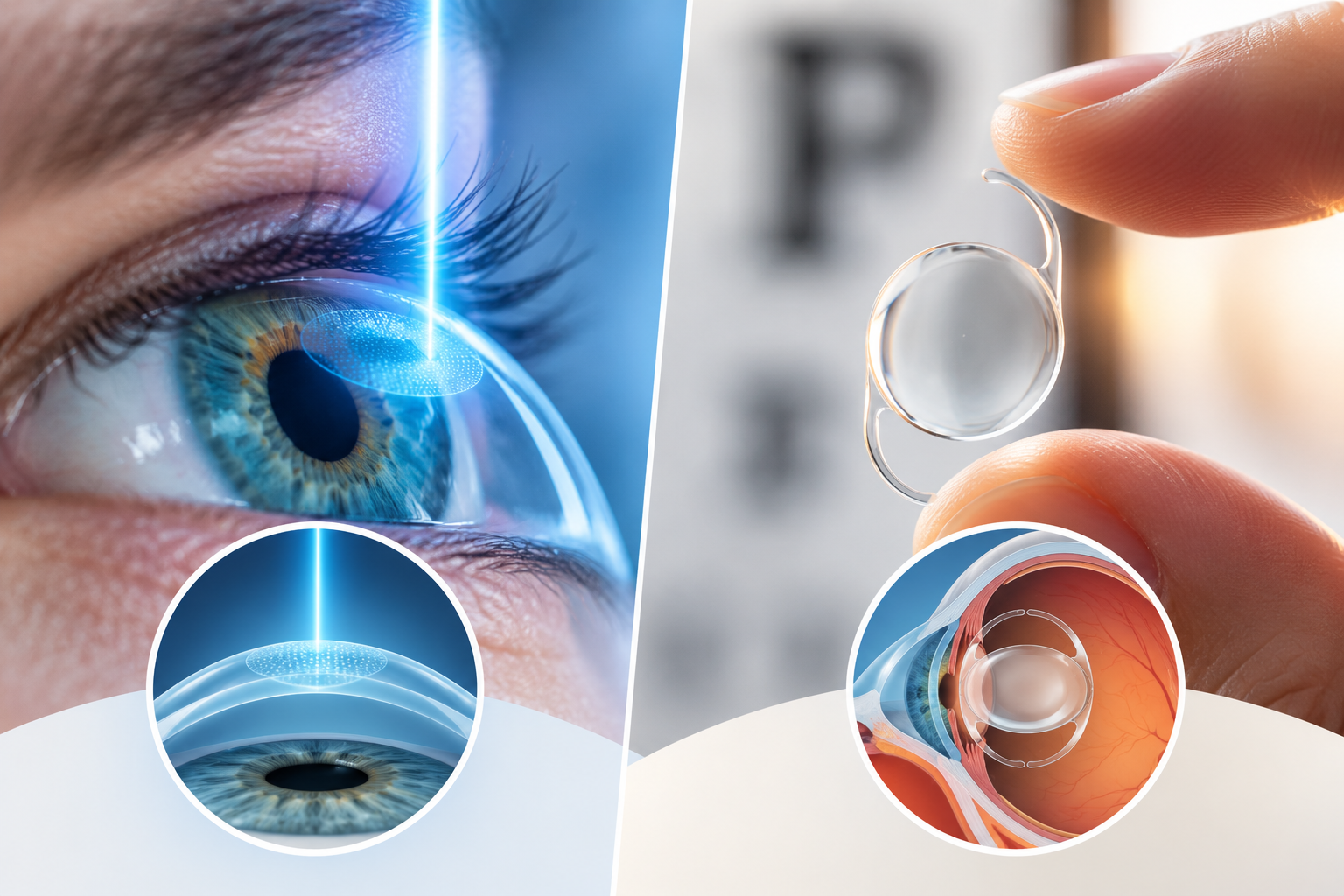
When weighing refractive lens exchange vs LASIK, the core difference is what each procedure changes: LASIK reshapes the cornea, while refractive lens exchange replaces the eye’s natural lens with a customized intraocular lens. LASIK generally suits younger patients with stable, moderate prescriptions, while RLE is often the better option for patients over 40 or those with extreme refractive errors.
Two Different Procedures, Two Different Goals
Patients researching vision correction often assume LASIK is the only option, but it isn’t the right fit for everyone. Refractive lens exchange (RLE) and LASIK both aim to reduce dependence on glasses or contacts, but they work in fundamentally different ways and are suited to different patients.
LASIK uses a laser to reshape the surface of the cornea, correcting how light bends as it enters the eye. It’s a laser-based procedure that leaves the eye’s natural lens untouched.
RLE takes a different approach entirely. It’s an elective outpatient procedure that removes the eye’s natural lens and replaces it with a customized intraocular lens (IOL) containing a vision prescription tailored to the patient’s eyes. Rather than adjusting the cornea, RLE addresses vision correction at the level of the lens itself.
How Each Procedure Works
LASIK involves creating a thin flap in the cornea, then using an excimer laser to reshape the underlying corneal tissue based on the patient’s specific refractive error. The flap is repositioned, and healing begins almost immediately. For patients who aren’t candidates for a corneal flap, laser alternatives such as PRK exist as well — you can compare those options in our PRK vs. LASIK breakdown.
RLE is a lens-based procedure that typically takes about 15 to 30 minutes per eye. The eye is numbed, a small incision is made, ultrasound energy is used to break up and remove the natural lens, and a new IOL is inserted through that same incision — generally without stitches. At Atlanta Vision Laser And Cataract Center, RLE is performed using premium intraocular lens brands, including TECNIS® and AcrySof® multifocal or extended-range lenses, which are selected based on each patient’s visual goals.
Who Tends to Be a Better Fit for Each
This is where the decision usually becomes clearer for most patients.
LASIK candidates are generally younger, have healthy corneas, and have refractive errors that fall within a moderate, stable range. Because LASIK works by reshaping existing corneal tissue, it isn’t designed to correct extreme nearsightedness, extreme farsightedness, or the natural loss of near focus that comes with age. Our full breakdown of who qualifies for LASIK covers these criteria, including age, prescription stability, and corneal health, in more detail.
RLE candidates are typically over 40 years old. Good candidates include:
- Patients with extreme nearsightedness or farsightedness that isn’t suitable for laser vision correction
- Patients with age-related farsightedness (presbyopia) who want reduced dependence on glasses or reading glasses
- Patients with certain eye conditions that disqualify them from laser-based procedures
Because RLE replaces the lens rather than reshaping the cornea, it can correct refractive errors that fall outside the range LASIK can safely address. This is one reason it’s often recommended as an alternative when LASIK isn’t a suitable option, an area our LASIK team evaluates closely during a candidacy exam, since corneal thickness, prescription stability, and age all factor into whether laser correction makes sense.
Recovery: What to Expect After Each Procedure
Recovery timelines differ meaningfully between the two procedures.
LASIK recovery is typically fast, with many patients noticing improved vision within a day or two and returning to most normal activities shortly after.
RLE recovery takes longer. Full healing can take up to eight weeks, though most patients resume normal daily activities within days to a couple of weeks. Patients are given healing eye drops and specific instructions on when they can resume driving, exercise, or swimming, since the eye needs time to adjust to the new lens.
| Refractive Lens Exchange (RLE) | LASIK | |
|---|---|---|
| What it changes | Replaces the eye’s natural lens | Reshapes the cornea |
| Typical candidate age | Over 40 | Younger, stable prescription |
| Procedure length | About 15–30 minutes | Shorter, laser-based |
| Full healing time | Up to 8 weeks | Days |
| Best for | High refractive errors, presbyopia | Moderate, stable prescriptions |
Understanding the Risks
Every surgical procedure carries some risk, and it’s worth understanding these clearly before deciding between refractive lens exchange vs LASIK.
With RLE, the most serious potential complication is retinal detachment, which carries a higher relative risk for patients with extreme nearsightedness or those under age 50. This is one of the key reasons RLE is generally recommended for patients over 40 rather than younger patients. Other potential risks include vision loss, posterior capsular rupture, and secondary cataracts, which are treatable if they occur. Encouragingly, about 95% of patients report being happy with their vision after RLE surgery.
LASIK carries its own set of risks related to the corneal flap and healing process, which is why a thorough candidacy evaluation, including corneal thickness measurements and a review of prescription stability, is essential before moving forward.
Can You Have Both, or Neither?
Some patients wonder whether LASIK and RLE can be combined or used sequentially. Because the two procedures address different parts of the eye’s optical system, some patients who have already had LASIK may later become candidates for RLE as they age and develop cataracts or presbyopia. However, whether a combined or sequential approach makes sense depends entirely on individual eye health and history. This is not a decision to make from general information alone.
The Only Way to Know for Sure
Reading about the differences between RLE and LASIK is a useful starting point, but it can’t replace a comprehensive eye exam. Corneal thickness, prescription stability, age, lens clarity, and overall eye health all factor into which procedure, if either, is right for a given patient. Our doctors, including Leonard Achiron, OD, who has co-managed more than 50,000 LASIK procedures, and David O’Day, MD, a Diplomate of the American Board of Ophthalmology who has performed over 80,000 LASIK procedures and specializes in cornea, cataract, and refractive surgery, evaluate each patient individually before recommending a path forward. You can learn more about our full physician team on our Meet the Doctors page.
If you’re trying to determine whether refractive lens exchange or LASIK is the better fit for your eyes, the most reliable next step is a comprehensive evaluation. Contact our Hapeville office at (404) 765-2020 to schedule a consultation and get a clear, personalized answer.
Frequently Asked Questions
Is refractive lens exchange more expensive than LASIK?
Pricing for both procedures depends on individual factors such as the lens technology chosen for RLE or the specific laser technique used for LASIK, as well as the number of eyes treated. Because RLE involves lens replacement and premium IOL options like TECNIS® and AcrySof® multifocal or extended-range lenses, it is generally a more involved procedure than LASIK. The most accurate way to understand cost differences for your specific situation is to schedule a consultation, where pricing can be discussed based on your exam results and treatment plan.
Is there an age cutoff for LASIK or RLE?
There isn’t a strict universal age cutoff for either procedure, but there are strong general guidelines. RLE works best for patients over 40, particularly because the risk of retinal detachment is higher for patients under 50, especially those with extreme nearsightedness. LASIK tends to be better suited to younger patients with stable, moderate prescriptions and healthy corneas. Age is one of several factors, alongside prescription strength and eye health, that a comprehensive exam will assess.
How does recovery time compare between RLE and LASIK?
LASIK recovery is typically quick, with many patients noticing improved vision within a day or two and resuming most normal activities shortly afterward. RLE recovery takes longer overall, with full healing taking up to eight weeks, although most patients return to normal daily activities within days to a couple of weeks. Both procedures come with specific instructions on driving, exercise, and swimming timelines, provided by your surgeon.
Can I have both LASIK and refractive lens exchange?
It’s possible for some patients to have LASIK earlier in life and later become candidates for RLE as they age, particularly if presbyopia or cataracts develop. Whether this sequence makes sense for a specific patient depends on their individual eye health history and current vision needs, which is why a personalized evaluation is necessary rather than a general answer.
Which procedure lasts longer, RLE or LASIK?
RLE involves replacing the eye’s natural lens with an artificial IOL, which does not develop cataracts the way a natural lens can, since the natural lens has been removed. LASIK reshapes the cornea, and while its correction is generally stable, the eye’s natural lens remains in place and can still develop age-related changes, including cataracts, later in life. This is one reason some LASIK patients consider RLE or cataract surgery years afterward.