
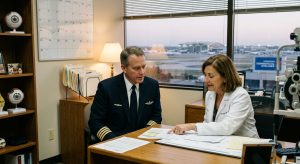
The FAA allows pilots to have LASIK, but you must not fly until your vision is stable, you meet vision standards, and your Aviation Medical Examiner clears you. Recovery times vary by person. Atlanta Vision Cataract and Laser Center in Hapeville offers LASIK consultations for pilots and airline crew.
Can Pilots Have LASIK and Still Hold an FAA Medical Certificate?
Yes. The FAA does not ban refractive surgery, and many pilots and airline employees around Atlanta choose LASIK to reduce their dependence on glasses and contact lenses. What the FAA cares about is the result. Your vision must meet the standard for your medical class once healing is complete, and you must be free of problems that could affect safe flying, such as significant glare, haze, or fluctuating vision.
Because Hartsfield-Jackson Atlanta International Airport is one of the busiest airports in the world, thousands of pilots, flight attendants, mechanics, and ramp crew live and work within a short drive of our Hapeville office. Many of them ask the same question: how soon can I get back to work?
What Vision Standards Does the FAA Require?
FAA medical standards focus on how well you see with or without correction. For pilots, the distance vision standard is generally 20/20 or better in each eye separately, with or without glasses or contacts. Near and intermediate vision are checked as well, and the exact requirements depend on the class of medical certificate you hold.
- Distance vision of 20/20 or better in each eye, with or without correction
- Near vision of 20/40 or better in each eye, with or without correction
- Intermediate vision testing for certain medical classes
- No eye conditions that could interfere with safe flying
Standards can change, so always confirm the current requirements for your certificate class with the FAA or your Aviation Medical Examiner, often called an AME.
How Soon Can a Pilot Fly Again After LASIK?
This is the question most pilots ask first, and the honest answer is that it depends on your healing and on your AME. FAA guidance has described a minimum of about two weeks after LASIK, provided your vision has stabilized and you have no complications. Many surgeons and aviation medical professionals recommend a longer, more cautious window, and some sources suggest several weeks before exercising full flight privileges.
The safest approach is to plan for more time off than the minimum. Healing is not identical in every patient, and you do not want to rush back into the cockpit with hazy or fluctuating vision. Never fly until your own eye surgeon and your AME agree that you are ready.
What Paperwork Does the FAA Need After Refractive Surgery?
After LASIK, the FAA generally expects documentation that your eyes have healed and your vision is stable. Your eye surgeon typically completes a refractive surgery status summary describing the procedure, your vision at follow-up visits, and whether you have any complications. Your AME then reviews that information during your medical exam.
- Details of the procedure, including the type of laser treatment
- Pre-operative measurements such as your prescription and corneal thickness
- Post-operative visual acuity at follow-up visits
- A statement about any complications, glare, haze, or fluctuating vision
Ask our team for a copy of your records early so you are not scrambling on the day of your exam.
Is LASIK or PRK Better for Pilots?
Both LASIK and PRK are accepted ways to correct vision for pilots, and the best option depends on your eyes. LASIK creates a thin corneal flap and usually has a faster visual recovery. PRK, which treats the surface of the cornea without a flap, can be a better fit for patients with thinner corneas, and it is often considered when a flap might be a concern. Healing after PRK usually takes longer, and the FAA timeline can be longer as well.
At Atlanta Vision, patients with thinner corneas may be better candidates for PRK surgery, and the doctors discuss both options during a consultation.
What Side Effects Should Pilots Know About?
Pilots depend on clear, steady vision in demanding conditions, so it helps to understand the common side effects of healing. Most are temporary, but they matter for anyone who flies for a living.
- Night glare and halos, which often improve during the first few months
- Dry eye, which can feel worse in low-humidity cockpits and on long flights
- Fluctuating vision as the cornea settles
- Light sensitivity in the early days of recovery
Dry eye in particular is common after LASIK. If you already struggle with dry eyes, read our article on LASIK with dry eye in Atlanta to learn how it is evaluated and treated before surgery.
What About Flight Attendants and Other Airline Crew?
Pilots hold FAA medical certificates, but other airline employees follow different rules. Flight attendants, ramp agents, and maintenance technicians usually do not need an FAA medical certificate, though your airline may have its own policies for return to work after surgery. Check with your employer or union representative before scheduling, and ask how much time off you will need.
How Should You Plan Your LASIK Around a Flight Schedule?
Airline schedules are demanding, so planning ahead makes a big difference. Many crew members choose a slower period, request enough days off to cover the first follow-up visits, and arrange for a ride home on surgery day. Our office is open Monday through Friday from 9 AM to 5 PM, so you can plan your appointments around your trips.
- Schedule your consultation several weeks before you want surgery
- Ask about the number of follow-up visits and when they will occur
- Talk to your AME before surgery so you know what to expect
- Plan extra recovery time before long-haul or overnight trips
How Do You Know If You Are a Candidate for LASIK?
Candidates generally need to be at least 18, have a stable prescription, and have healthy eyes with enough corneal thickness. A full exam and corneal measurements tell the doctors whether LASIK, PRK, or another option makes the most sense. You can read more on our page about LASIK candidacy.
Our experienced eye doctors, optometrist Dr. Leonard Achiron, OD, and ophthalmologist Dr. David O’Day, MD, have performed more than 80,000 LASIK procedures combined, and the practice uses the VISX Star S4 IR Excimer Laser with wavefront technology. You can learn more about the team on the Meet the Doctors page.
What Should You Do in the Weeks Before Your Procedure?
Preparation starts well before surgery day. Contact lens wearers are usually asked to stop wearing their lenses for a set period so the cornea can return to its natural shape, and your surgeon will tell you exactly how long. During that time you will need to rely on glasses, which is worth planning around if your job requires you to see clearly at all times.
- Follow your surgeon’s instructions about stopping contact lens wear
- Bring a list of all medications and supplements to your consultation
- Tell your doctor about any history of dry eye, allergies, or eye infections
- Check your medical certificate expiration date and AME appointment schedule
How Do You Keep Your Vision Steady During Long Duty Days?
After healing, many pilots and crew members say the biggest change is freedom from glasses and contacts on long duty days. Still, your eyes may feel drier than before in the dry air of an aircraft, especially in the first few months. Keep lubricating drops handy, take visual breaks when it is safe to do so, and tell your surgeon if symptoms interfere with your work.
If you are comparing options, you can also review our overview of enhancements and touch-ups after LASIK, since pilots sometimes ask what happens if a small prescription remains after healing.
What Happens at Follow-Up Visits After LASIK?
Follow-up visits are where your surgeon confirms that your eyes are healing as expected. Early checks usually take place within the first day or two, with additional visits over the following weeks and months. At each visit, the doctors measure your vision, examine the surface of your eye, and ask about glare, dryness, and any fluctuations. For pilots, those records become the proof your AME will want to see, so attend every appointment and keep copies.
Why Do Atlanta Pilots and Crew Trust Our Vision Center?
Aviation professionals need an eye care provider who understands what is at stake. Atlanta Vision Cataract and Laser Center is a trusted vision center in Hapeville that has served the Atlanta area for more than 20 years, and LASIK is our top priority. Our team includes an experienced optometrist and an ophthalmologist, so you can work with the right vision specialist for LASIK planning, follow-up care, and records for your Aviation Medical Examiner. We also offer comprehensive eye exams to help you keep your eyes healthy between medical certificate renewals.
A Note on General Information
This article is general information and not medical or aviation advice. FAA rules, waiting periods, and paperwork can change, and every patient heals differently. Talk with your eye surgeon and your Aviation Medical Examiner before making decisions about surgery or returning to flight duty.
Schedule a LASIK Consultation Near Hartsfield-Jackson
If you fly out of Atlanta and want to explore LASIK, contact Atlanta Vision Cataract and Laser Center at (404) 765-2020 to schedule a consultation at 3619 South Fulton Avenue #101, Hapeville, GA 30354. We welcome patients from Hapeville, Atlanta, East Point, College Park, Forest Park, and surrounding communities.