
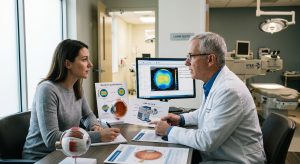
The VISX Star S4 IR is an excimer laser that uses iris registration, three-dimensional eye tracking, and variable spot scanning, and it can be paired with wavefront data for customized LASIK. Technology helps, but your surgeon matters most. Atlanta Vision Cataract and Laser Center uses it for LASIK in Hapeville.
What Is the VISX Star S4 IR Excimer Laser?
The VISX Star S4 IR is an excimer laser used to reshape the cornea during laser vision correction. It is an FDA-approved system that uses cool ultraviolet light to remove microscopic amounts of corneal tissue, changing how the eye focuses light. It is widely used for LASIK and surface treatments such as PRK to correct nearsightedness, farsightedness, and astigmatism.
Atlanta Vision Cataract and Laser Center uses the VISX Star S4 IR Excimer Laser with wavefront technology, and our experienced eye doctors, an optometrist and an ophthalmologist, have performed more than 80,000 LASIK procedures combined. Understanding what each feature does can help you ask better questions during a consultation.
What Does Iris Registration Do?
Iris registration, or IR, is a method of aligning the treatment to your eye. Your eye can rotate slightly when you move from sitting upright during measurements to lying down for surgery. Iris registration compares the unique pattern of your iris from the earlier measurements to its position during the procedure and adjusts the treatment so it lines up correctly. This matters most when astigmatism is being corrected, because the treatment must be placed on the right axis.
How Does Three-Dimensional Eye Tracking Work?
No one can hold their eye perfectly still. Tiny movements happen all the time. The ActiveTrak system follows the motion of the eye in three dimensions during the treatment, so the laser stays aligned with your eye even if it shifts slightly. You are asked to look at a light, but the tracking system, not your ability to stay motionless, is what keeps the treatment on target.
What Is Variable Spot Scanning?
Variable spot scanning lets the laser use different beam sizes during the treatment. Larger spots can cover wider areas efficiently, and smaller spots add finer detail where needed. The system also blends the edges of the treatment area, and the manufacturer describes this as a way to reduce the chances of glare and halos at night. As with any technology, results vary from patient to patient.
What Is Wavefront-Guided LASIK?
Traditional LASIK corrects the basic prescription you would find on a glasses prescription. Wavefront-guided LASIK goes further. A wavefront device measures how light travels through your eye and creates a detailed map of its imperfections, including subtle irregularities called higher-order aberrations. These can affect the quality of your vision, especially at night. That map guides the laser so the treatment is customized to your eye.
- A wavefront scan creates a unique map of how your eye focuses light
- The map is used to plan a treatment designed for your eye
- Customized treatments may help reduce night vision issues for some patients
- Not everyone is a candidate for the same treatment, so your doctor will advise you
Does Better Technology Mean Better Results?
Technology is an important part of the picture, but it is not the whole story. Even the most advanced laser depends on a careful exam, good surgical planning, a healthy cornea, and an experienced surgeon. Healing, dry eye, and your own anatomy all influence the outcome. Be cautious of any practice that suggests a laser can promise a specific result.
The best approach is to look at the whole experience: the technology, the doctors, the follow-up care, and how clearly they explain your options.
What Should You Ask Your LASIK Surgeon?
A consultation is your chance to understand how the procedure will be planned and performed. Bring a list of questions, and do not be afraid to ask them directly.
- Which laser will you use, and is it a wavefront-guided treatment for my eyes?
- Am I a good candidate for LASIK, or would PRK or another option fit better?
- How thick are my corneas, and how much tissue will be removed?
- How is the corneal flap created, and why do you recommend that approach?
- Who performs the procedure, and who handles my follow-up visits?
- What happens if I need an enhancement, and what would it cost?
- What risks and side effects, such as dry eye and night glare, should I expect?
How Do Candidacy and Corneal Thickness Affect the Plan?
Candidates generally need to be at least 18, with a stable prescription and healthy eyes. Corneal thickness is a key safety measurement, because LASIK removes tissue and enough must remain for the cornea to stay strong. Patients with thinner corneas may be better suited for PRK surgery. You can read more about who may qualify on our LASIK candidacy page.
What Is the Experience Like on Surgery Day?
Surgery day is usually calm and quick. Numbing drops are placed in your eyes, and the surgeon creates a thin flap, folds it back, and uses the excimer laser to reshape the cornea. The laser portion often takes just a few minutes, and the whole procedure typically takes about 10 to 15 minutes per eye. Many patients notice improved vision within about 24 hours, and initial burning, itching, or a feeling like something is in the eye usually fades quickly.
If you have dry eye, read about LASIK with dry eye so you know how it is handled before and after surgery.
What Does LASIK Cost at Atlanta Vision?
The practice lists an average of about $2,000 per eye, and the final price depends on your technology and the complexity of your treatment. Flexible payment solutions, including 0% financing through CareCredit, are available. Visit our LASIK pricing page for current information.
Who May Not Be a Good Candidate for Wavefront-Guided LASIK?
Wavefront-guided treatments are not right for everyone. Patients with thin corneas, certain corneal diseases such as keratoconus, unstable prescriptions, or severe dry eye may not be candidates for LASIK at all. Some patients may be better served by PRK, and others may need a different kind of treatment altogether. A complete examination, including corneal mapping, is how your doctor decides.
People with keratoconus may benefit from other options, and our practice offers care in that area as well. Learn more about the full range of care on our services page.
What Are the Possible Side Effects and Risks?
Every surgery has risks, and responsible practices explain them openly. Common temporary effects after LASIK include dryness, light sensitivity, glare, halos, and fluctuating vision as the eye heals. A small number of patients experience long-term issues or need an enhancement.
- Dry eye, which is common and usually improves over weeks to months
- Night glare or halos, which often improve as healing continues
- Under- or over-correction, which may be addressed with an enhancement
- Rare complications involving the flap or the cornea, which your surgeon will review with you
Advanced technology is designed to improve precision, but it does not remove every risk. If you would like to understand what happens when a prescription needs fine-tuning, read our guide to LASIK enhancements.
How Do You Compare LASIK Practices in Atlanta?
Comparing practices is more than comparing lasers. Look at how thorough the exam is, how clearly the doctors explain your risks, how many follow-up visits are included, and how they handle problems after surgery. A practice with decades of experience and a large number of procedures can offer helpful perspective, but you should still feel comfortable asking questions and getting honest answers.
Is the VISX Star S4 IR Still Considered Modern Technology?
The VISX platform has been used in laser vision correction for many years, and that long track record is one reason many surgeons trust it. A long history means a large body of published results and surgeon experience, which is valuable when you are choosing a procedure on your eyes. Ask your surgeon how often they use the system and how they customize treatments for each patient.
New devices appear regularly, but newer does not always mean better for your particular eyes. Your examination results and your surgeon’s judgment should guide the choice.
Why Choose a Trusted Vision Center for LASIK Technology?
Advanced technology works best in the hands of an experienced team. Atlanta Vision Cataract and Laser Center is an expert eye care provider that has served Hapeville and Atlanta for more than 20 years, and LASIK with the VISX Star S4 IR Excimer Laser is our top service. Your optometrist and ophthalmologist review your measurements, explain your options, and stay with you through follow-up visits. If LASIK is not the right fit, we also offer PRK, refractive lens exchange, and cataract surgery.
A Note on General Information
This article is general information and not medical advice. Technology descriptions are based on published information about the laser system, and your own results depend on your eyes and healing. Ask your surgeon about your specific treatment plan.
Meet With Our Doctors in Hapeville
To find out whether wavefront-guided LASIK is right for you, contact Atlanta Vision Cataract and Laser Center at (404) 765-2020. We are located at 3619 South Fulton Avenue #101, Hapeville, GA 30354, and our office is open Monday through Friday from 9 AM to 5 PM.